

Why Communication Changes with Dementia
Dementia affects the brain's ability to process and produce language, making communication increasingly difficult as the disease progresses. According to the Alzheimer's Association, people with dementia may struggle to find the right words, understand what others are saying, or follow conversations.
These changes can be frustrating for both the person with dementia and their family members. But with the right techniques, meaningful connection is still possible—even in later stages of the disease.
How Dementia Affects Communication
Communication challenges vary depending on the type and stage of dementia, but common changes include:
- Word-finding difficulties: Struggling to think of the right word or using substitute words
- Repetition: Asking the same questions or telling the same stories repeatedly
- Losing train of thought: Stopping mid-sentence or losing track of what they were saying
- Difficulty following conversations: Especially when multiple people are talking or topics change quickly
- Reverting to native language: People who learned English as a second language may return to their first language
- Reduced vocabulary: Using fewer and simpler words over time
- Difficulty reading and writing: These skills often decline as dementia progresses

10 Techniques for Better Dementia Communication
1. Approach Calmly and Identify Yourself
Start every interaction by approaching from the front and getting their attention before speaking. People with dementia may startle easily or may not remember who you are, even if you're a close family member.
How to approach:
- Approach from the front where they can see you coming
- Make eye contact before speaking
- Identify yourself by name and relationship: "Hi Mom, it's Sarah, your daughter"
- Use a gentle, calm tone of voice
- Don't take it personally if they don't recognize you—this is the disease, not rejection
2. Speak Slowly and Clearly
The brain processing speed slows with dementia, so speaking slowly gives them time to understand.
Speaking tips:
- Speak at a slightly slower pace than normal
- Pause between sentences to allow processing time
- Use a lower-pitched voice (high pitches can be harder to hear and understand)
- Pronounce words clearly without exaggerating
- Avoid speaking loudly unless they have hearing problems—louder doesn't help comprehension
3. Use Simple Words and Short Sentences
Keep your language simple and direct. Long, complex sentences with multiple ideas are difficult for someone with dementia to follow.
Examples:
- Instead of: "Would you like to go to the kitchen and sit down so we can have some lunch together?"
- Say: "Let's eat lunch." (Then) "Come to the kitchen with me."
Guidelines:
- One idea per sentence
- Use familiar, concrete words rather than abstract concepts
- Avoid pronouns when possible—use names instead of "he," "she," or "they"
- Be specific rather than vague
4. Ask One Question at a Time
Multiple questions or choices overwhelm the brain's processing ability. Break things down into single, simple questions.
Examples:
- Instead of: "Do you want eggs or cereal for breakfast, and do you want coffee or juice?"
- Say: "Do you want eggs?" (Wait for response) "Do you want coffee?"
Tips for questions:
- Ask yes/no questions when possible
- Limit choices to two options
- Wait patiently for a response—it may take 30 seconds or more
- If they don't answer, rephrase the question rather than repeating it exactly
5. Give Time for Responses
Processing time increases with dementia. What seems like silence may be them working on a response.
How to allow processing time:
- After asking a question, wait at least 20-30 seconds before repeating or rephrasing
- Don't interrupt their thinking process
- Avoid finishing their sentences unless they're clearly frustrated and looking for help
- Be patient with pauses and silences
- If they seem stuck, gently offer a cue or suggest a word
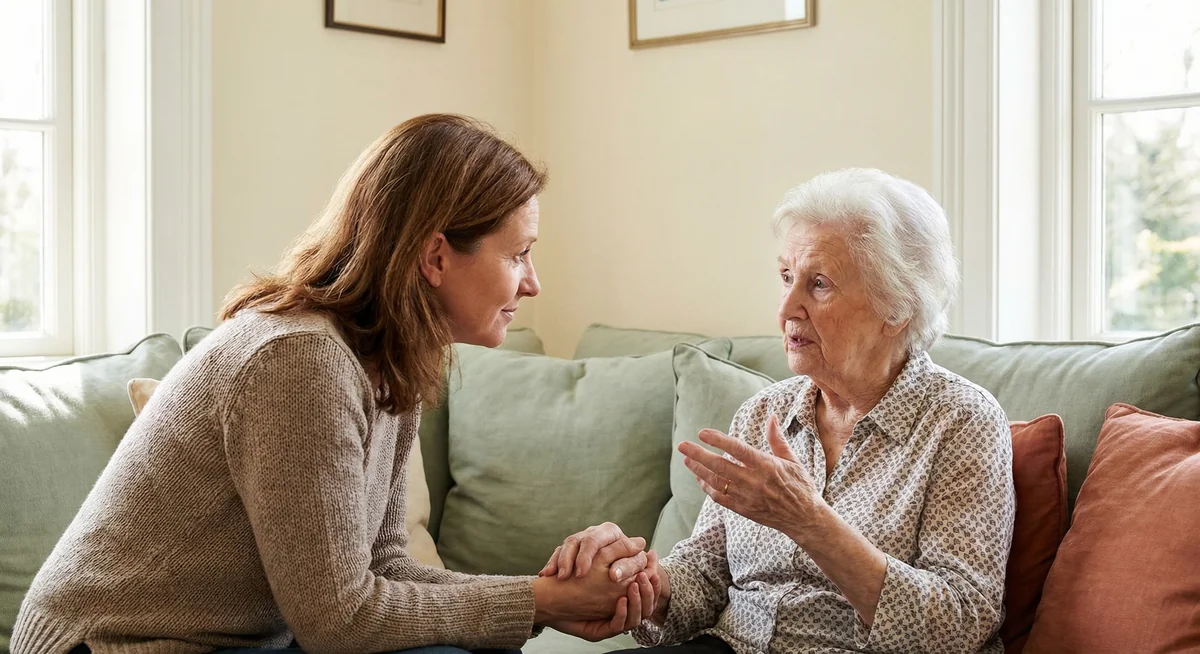
6. Use Visual Cues and Gestures
Non-verbal communication becomes increasingly important as verbal abilities decline. Visual cues help reinforce your message and aid understanding.
Effective non-verbal strategies:
- Point to objects you're talking about
- Use gestures to demonstrate what you mean (mime brushing teeth while asking about it)
- Show them the item you're discussing rather than just naming it
- Use pictures or written cues for daily routines
- Maintain warm facial expressions and body language
7. Listen with All Your Senses
As words become more difficult, people with dementia communicate through behavior, facial expressions, and body language. Pay attention to what they're expressing beyond words.
Watch for:
- Facial expressions that show emotion
- Body language indicating comfort or distress
- Tone of voice
- Gestures and pointing
- Behavioral changes that may indicate needs (pacing might mean they need the bathroom)
Try to understand the emotion behind what they're saying, even if the words don't make sense. Respond to the feeling rather than correcting the content.
8. Avoid Arguing or Correcting
Correcting mistakes or arguing about facts rarely helps and often causes distress. The goal is connection, not accuracy.
Instead of correcting:
- If they say something factually wrong, redirect rather than correct
- If they think a deceased loved one is still alive, don't insist on the truth—this causes them to re-experience the grief
- If they accuse you of something untrue, don't argue—acknowledge their feeling and redirect
- Go along with harmless beliefs rather than insisting on reality
Example:
- They say: "I need to pick up my children from school."
- Instead of: "Your children are grown. They're in their 50s now."
- Try: "Tell me about your children. What are their names?"
9. Focus on Feelings, Not Facts
Even when words fail, emotions remain. The ability to feel connected, loved, and valued persists long after the ability to communicate verbally declines.
Ways to connect emotionally:
- Acknowledge their emotions: "You seem upset. I'm sorry you're feeling that way."
- Use touch appropriately—hold hands, pat their shoulder, offer a hug
- Match your tone to theirs when appropriate
- Share moments of joy, laughter, or reminiscence
- Express love and reassurance frequently
A person with dementia may forget what you said, but they often remember how you made them feel.
10. Create a Calm Environment
Environmental factors significantly impact communication ability. Reducing distractions helps them focus on the conversation.
Environmental adjustments:
- Turn off the TV or radio when talking
- Move to a quiet room with minimal distractions
- Reduce background noise
- Ensure good lighting so they can see your face and lips
- Limit the number of people in conversations
- Choose times when they're well-rested and calm
Communication at Different Stages
Communication needs and abilities change as dementia progresses. Here's what to expect at each stage:
Early Stage
In early dementia, communication is still largely intact but may include:
- Occasional word-finding difficulties
- Some repetition of stories or questions
- Difficulty following complex conversations
Approach: Be patient with word-finding. Involve them in conversations and decisions. Don't speak for them.
Middle Stage
Communication becomes more challenging:
- More significant word-finding problems
- Difficulty following conversations
- May confuse past and present
- Increased reliance on non-verbal communication
Approach: Use simpler language. Rely more on visual cues. Focus on feelings over content.
Late Stage
Verbal communication may be very limited:
- May speak only a few words or none at all
- May not understand most speech
- Communicates primarily through behavior and sounds
Approach: Use touch, tone of voice, and presence to connect. Pay attention to non-verbal cues for needs and emotions. Continue talking to them—hearing familiar voices is comforting.
When Communication Breaks Down
Even with the best techniques, there will be moments of frustration. When communication isn't working:
- Take a break: Step away for a few minutes to reset
- Try again later: Time of day affects communication ability
- Change the subject: Sometimes moving on is better than pushing through
- Use distraction: Redirect to something pleasant
- Accept imperfection: Not every interaction will go smoothly
At Home Healers Dementia Care Services
At At Home Healers, our caregivers are trained in dementia communication techniques. With over 20 years of combined experience, we understand that connecting with someone who has dementia requires patience, skill, and compassion.
Our specialized dementia care includes:
- Trained caregivers: Skilled in communication techniques for all stages of dementia
- Consistent care: Familiar caregivers who learn your loved one's communication patterns
- Family education: We share techniques that help families connect better
- Meaningful engagement: Activities appropriate to cognitive abilities
- Companionship: Regular social interaction that maintains connection
We serve families throughout Fort Wayne and Northeast Indiana, including Fort Wayne, Auburn, Huntington, and surrounding communities.
Contact us for a free consultation to discuss how we can help your family communicate better with your loved one.


