

The Shift No Family Expects
According to the Alzheimer's Association, 6 in 10 people living with dementia will wander at least once, and many will do so repeatedly -- often with life-threatening consequences (Alzheimer's Association, 2024 Alzheimer's Disease Facts and Figures). That single statistic captures something families discover gradually: dementia doesn't just affect memory. It erodes judgment, spatial awareness, and the ability to recognize danger.
Most families don't wake up one morning and decide their parent needs 24-hour home care. The realization builds. A pot left on the stove. A 3 a.m. phone call from a neighbor who found Dad walking down the street in his pajamas. Medications taken twice -- or not at all. Each incident chips away at the assumption that your loved one can manage alone, even for a few hours.
Understanding how dementia progresses through its stages helps families anticipate when that shift is coming. But every person's path is different, and the timeline can surprise you.
Warning Signs That 24-Hour Supervision Is Needed
Not every person with dementia needs round-the-clock care right away. In early stages, reminders and check-ins may be enough. But there are clear signals that the window of safe independence is closing. Watch for these:
Wandering and Exit-Seeking Behavior
Wandering is among the most dangerous dementia behaviors. The Alzheimer's Association reports that if a person with dementia who wanders is not found within 24 hours, up to half will suffer serious injury or death (Alzheimer's Association, "Wandering and Getting Lost"). This isn't about a casual stroll. People with dementia may try to leave home at any hour, often believing they need to go to work or find a deceased family member.
If your loved one has attempted to leave the house unsupervised -- even once -- that's a red flag. Learn more about how to prevent wandering in dementia patients and what safety measures can help.
Forgetting the Stove, Oven, or Running Water
The National Institute on Aging warns that fire and burn injuries rank among the top safety hazards for people with Alzheimer's disease, particularly when they forget cooking appliances are on or attempt to cook without supervision (NIA, "Home Safety and Alzheimer's Disease"). If your parent has left burners running, forgotten food in the oven, or left water overflowing in the tub more than once, supervision gaps are becoming dangerous.
Medication Errors
Skipping doses. Doubling doses. Taking the wrong pills. Medication mismanagement in dementia isn't about being forgetful -- it's about losing the cognitive ability to follow a routine safely. When pill organizers and reminder apps stop working, human oversight becomes the only reliable safeguard.
Nighttime Confusion and Sundowning
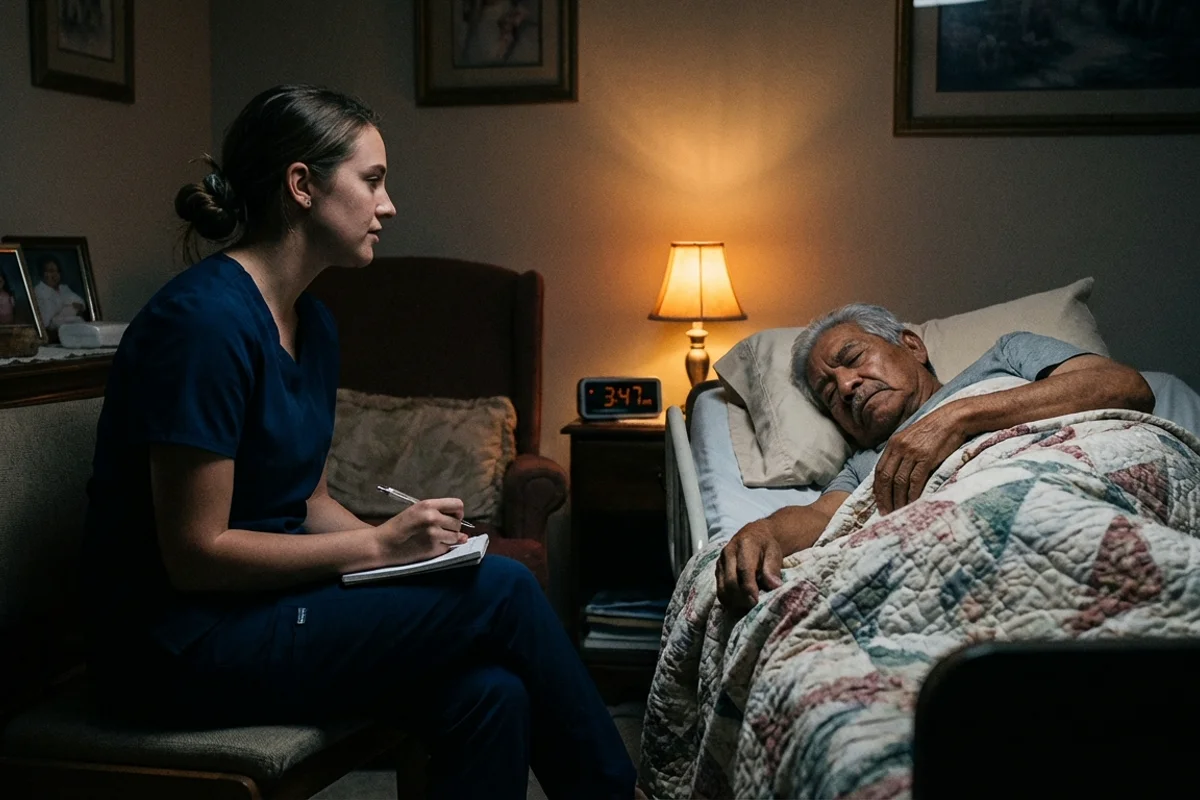
Sundowning -- the pattern of increased agitation and confusion in the evening and overnight hours -- affects a significant number of people with mid-stage dementia. The National Institute on Aging notes that sleep disturbances and nighttime restlessness are common features of Alzheimer's disease that create safety risks when no one is present to redirect and reassure.
A person experiencing sundowning may try to leave the home, become combative, or fall while disoriented in the dark. Nighttime is when many families realize that daytime-only care isn't enough.
Repeated Falls
The CDC reports that adults aged 65 and older experience approximately 36 million falls each year, and those with cognitive impairment face substantially higher fall risk (CDC, "Falls Are Leading Cause of Injury and Death in Older Americans"). For someone with dementia, a fall doesn't just risk a broken hip. It can trigger a rapid cognitive decline from hospitalization, anesthesia, or the disruption of familiar routines.
If your parent has fallen multiple times, especially when alone, it's time to seriously evaluate whether gaps in supervision are putting them in harm's way. Our guide on 10 signs your parent needs round-the-clock care walks through the full picture.
Safety Risks at Each Stage
Understanding what dementia actually does to the brain helps explain why supervision needs intensify over time.
Early Stage: Your loved one may forget appointments, misplace items, or repeat questions. They can usually manage basic daily tasks but may need help with finances, driving decisions, and complex planning. Periodic check-ins and structured routines often work at this point.
Middle Stage: This is where the safety equation changes dramatically. Judgment declines. Your parent may not recognize that a situation is dangerous. They might leave the house in freezing weather without a coat, attempt to drive, or interact with strangers at the door without caution. The middle stage is when most families find themselves needing specialized dementia care beyond what they can provide alone.
Late Stage: Communication becomes limited. Mobility decreases. Your loved one needs help with eating, bathing, toileting, and repositioning. At this point, 24-hour supervision isn't a question -- it's a medical necessity. The risk isn't just wandering anymore; it's choking, skin breakdown, infections, and aspiration.
The Middle Ground: Partial Supervision vs. Full 24-Hour Care
Many families try to bridge the gap between independence and full-time supervision. That's natural -- and sometimes, transitional care works well for a season.
What partial supervision looks like:
- A caregiver visits for 4-8 hours during the day
- Family members cover evenings and weekends
- A 1-on-1 sitter stays during specific risk windows
- Technology like door alarms and cameras fill some gaps
When partial supervision stops working:
- Your loved one has incidents during unsupervised hours
- Family caregivers are exhausted, sleep-deprived, or burned out
- The person with dementia needs hands-on help at unpredictable times
- Nighttime behaviors require someone awake and alert
The honest truth is that partial supervision works until it doesn't. And families often find out it's no longer enough through a scare -- a fall, a wandering episode, or a medical emergency that happened during a gap in coverage.

How Families Typically Realize It's Time
In our experience working with families across Fort Wayne and northeast Indiana, the moment of realization rarely comes from a single event. It's cumulative. Here's what we hear most often:
"I can't sleep anymore." Family caregivers who live with their loved one describe lying awake, listening for sounds of movement, dreading the moment they hear the front door open at 2 a.m. Sleep deprivation changes everything -- your health, your patience, your ability to provide safe care.
"I found out something happened while I was at work." A neighbor called. The mail carrier noticed something odd. The smoke detector went off. Families often learn about safety incidents secondhand, and each one adds a layer of fear about what might happen next time.
"Mom doesn't know where she is in her own house." When spatial confusion extends to familiar environments, the risk of falls, burns, and other accidents rises sharply. A person who can't find the bathroom in the home they've lived in for 30 years needs someone nearby at all times.
"Dad got aggressive, and I couldn't handle it." Behavioral changes in mid-to-late dementia -- aggression, paranoia, refusal of care -- can make it unsafe for a single family caregiver to manage alone. Having trained support isn't a failure. It's the right call. If you're noticing these patterns, here are seven signs it may be time for professional dementia care.
What 24-Hour Dementia Supervision Looks Like at Home
Round-the-clock care at home doesn't mean your loved one loses their independence overnight. Good dementia supervision preserves as much autonomy as possible while removing the dangers.
Daytime support includes:
- Assistance with meals, medications, and personal care
- Engaging activities tailored to their cognitive level -- music, gentle exercise, sorting tasks, reminiscing
- Monitoring for wandering, agitation, or unsafe behaviors
- Accompanying them on walks, to appointments, or around the home
Overnight support includes:
- A caregiver who stays awake or is immediately available
- Bathroom assistance and fall prevention during nighttime
- Redirection during sundowning episodes
- Comfort and reassurance when confusion peaks in the dark
What makes it work:
- Consistent caregivers who know your loved one's personality and triggers
- A structured daily routine that reduces anxiety
- Close communication between the care team and family
- Flexibility to adapt as needs change week to week
The goal isn't to take over your parent's life. It's to wrap a safety net around them so they can remain in the home they know, with the people they love nearby.
The Emotional Side: Guilt, Grief, and Getting Through It
Let's talk about what no care guide usually addresses: how this feels.
Arranging 24-hour supervision for a parent with dementia brings up grief. You're grieving the person they were. You're grieving the relationship you had. You may feel guilt for not being able to do it all yourself, or relief that someone else is sharing the weight -- and then guilt about the relief.
All of that is normal.
Bringing in professional caregivers doesn't mean you've given up on your parent. It means you've recognized that loving someone and being their full-time medical caretaker are two different things. You can be a devoted daughter or son while also admitting you need help. In fact, respite care exists specifically to give family caregivers the break they need to sustain their own wellbeing.
The families we work with often tell us the same thing after making the transition: "I wish we'd done this sooner." Not because they weren't trying hard enough before. But because once the safety net was in place, they could go back to just being family again -- sitting with Mom, holding her hand, playing her favorite songs -- instead of being on high alert every moment.
At Home Healers 24-Hour Dementia Care Services
At Home Healers provides 24-hour home care and specialized dementia care throughout northeast Indiana. Our caregivers receive focused training in dementia behaviors, redirection techniques, fall prevention, and compassionate communication.
We serve families in Fort Wayne, Auburn, Huntington, and surrounding communities.
Whether your loved one needs a dedicated sitter during high-risk hours or full round-the-clock supervision, we build a care plan that fits your family's specific situation.
Ready to talk about what your parent needs? Contact us to schedule a free in-home consultation. We'll walk through your loved one's current abilities, safety concerns, and care options -- with zero pressure and zero judgment.
Frequently Asked Questions
What are the signs that someone with dementia needs 24-hour care?
Key warning signs include wandering or exit-seeking behavior, leaving the stove or appliances on, medication errors, nighttime confusion or sundowning, and repeated falls. Any of these indicate that gaps in supervision are becoming dangerous.
Can someone with dementia live alone?
In early stages, many people with dementia can live alone with check-ins and structured routines. However, as the disease progresses to middle stages, judgment and safety awareness decline significantly, making unsupervised time increasingly risky.
How much does 24-hour dementia care cost at home?
In Indiana, 24-hour home care typically ranges from $15,000 to $20,000+ per month depending on the level of care needed. Many families combine insurance, Medicaid waivers, and VA benefits to cover costs.


